

By Daniel Craig, Founder, Reknown
How much have hotels embraced artificial intelligence (AI), and what’s holding back those that haven’t?
A recent survey of 1,500 hotels across Europe from HES-SO Valais-Wallis University in Switzerland offers some valuable insights.
Here are a few highlights:
AI Adoption by Hotels
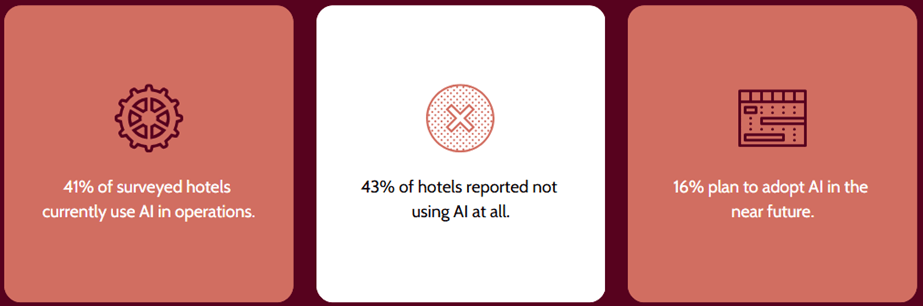
Among surveyed hotels:
- 41% reported using AI
- 16% plan to adopt it in the near future
- 43% do not currently use it
When compared with a similar 2023 study, the results show “a clear and significant acceleration in the adoption of AI-based technologies in hotel operations,” according to the report’s authors, led by Prof. Roland Schegg.
The Impact of AI
Overall, hoteliers rated the impact of AI on the industry as moderately positive, with an average score of 6.1 out of 10. Among hotels already using AI, the rating was higher, at 6.6.
According to the report, “Larger, better-staffed, urban hotels with higher service standards are significantly more likely to view AI as impactful,” whereas “small, rural or seasonal hotels with limited staff tend to be more skeptical.”
Top Perceived Benefits of AI
The top benefits cited by hotels already using or considering AI include:
- Time savings (76%)
- Improved communication and marketing (54%)
- Improved operational efficiency (51%)
- Improved data management and analysis (44%)
- Increase in sales (40%)
Most Useful Areas for AI
Asked where AI could be most useful in hotel operations, hoteliers pointed to:
- Reservations (68%)
- Marketing (62%)
- Customer relationship management (51%)
- Data analysis and reporting (49%)
- Personalization of the customer experience (45%)
Again, the responses reveal a divide between large and small hotels. Larger properties tend to see broader applications across departments, while smaller hotels are more focused on marketing and reservations.
Notably, hotels with higher star ratings (4- and 5-star) show greater belief in AI’s potential across a wide range of functions.
AI Technologies in Use
Among the most commonly used AI tools:
- Generative AI platforms like ChatGPT and Gemini (74%)
- Review analysis tools (44%)
- Dynamic pricing tools (42%)
- Personalized service tools (38%)
- Predictive analytics (37%)
Barriers to Adoption
The most commonly cited obstacles to AI adoption include:
- Poor knowledge about available AI solutions (39%)
- High setup costs (35%)
- Technical complexity (34%)
- Difficulty integrating AI into existing processes (34%)
- Lack of technical skills (32%)
In open comments, hoteliers also expressed concerns around data privacy and regulations (especially GDPR), limited resources, unclear timing or strategic value, and emotional or ethical issues such as fear of losing the human touch.
Overcoming the Barriers
While obstacles to AI adoption are declining, they haven’t disappeared. And what works for one type of hotel might not suit another.
The findings echo what I hear in my own conversations with hoteliers around the world. About half are actively experimenting with AI and seeing real benefits. The other half are either disengaged or disillusioned by the surrounding hype.
In either case, success with AI requires a holistic approach.
“True value comes not from isolated tools, but from integrating AI into a broader digital strategy that aligns with business goals, guest experience ambitions, and operational realities,” the report notes.
That means commitment from leadership, active staff involvement, and a cultural shift toward innovation, agility, and ongoing learning.
As the authors put it, “The future will belong to those who can pair human warmth with intelligent systems and lead their organizations through the next wave of digital transformation.”
Kudos to Prof. Schegg and his team at HES-SO Valais-Wallis University for putting together a thoughtful and insightful report. It’s great to have some data directly from hotels to understand how AI is transforming the industry (or not).
Click here to view the full report, including detailed survey results by country and hotel type.